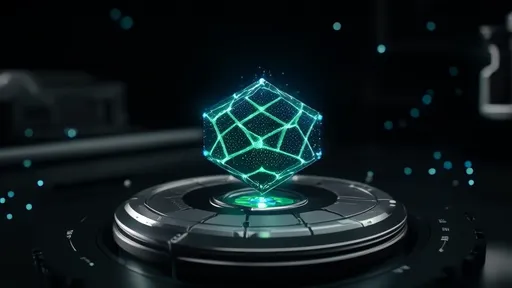
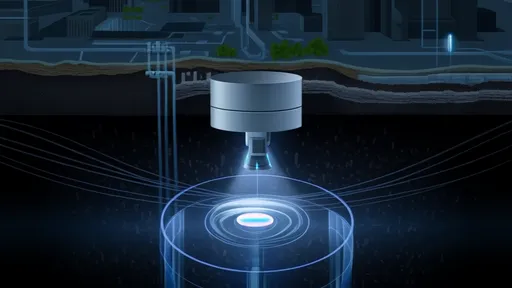
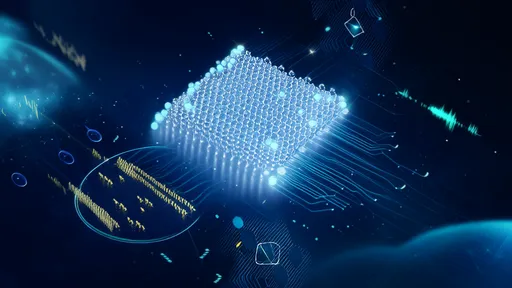
The dream of a global quantum internet has taken a significant leap forward with the development of photon quantum repeaters. These devices act as crucial relay stations, enabling quantum communication over distances that were previously unimaginable. Unlike classical repeaters, which simply amplify signals, quantum repeaters preserve the delicate quantum states of photons, making them indispensable for long-distance quantum networks.
Quantum communication relies on the transmission of quantum bits, or qubits, typically encoded in the properties of photons. However, photons can be absorbed or scattered as they travel through optical fibers, limiting the range of quantum communication to a few hundred kilometers. This is where photon quantum repeaters come into play. By effectively extending the reach of quantum signals, these devices pave the way for secure, high-speed communication across continents.
The principle behind quantum repeaters is rooted in quantum entanglement, a phenomenon where particles become intrinsically linked, regardless of the distance separating them. By creating entangled pairs of photons at intermediate nodes, quantum repeaters can transmit information over thousands of kilometers without losing the quantum properties that make such communication secure and efficient. This breakthrough could revolutionize fields ranging from cybersecurity to distributed quantum computing.
One of the most promising aspects of photon quantum repeaters is their potential to enable unhackable communication. Quantum key distribution (QKD), a method for secure communication, relies on the fact that any attempt to eavesdrop on a quantum signal will disturb its state, alerting the parties involved. With quantum repeaters, QKD could be implemented on a global scale, ensuring that sensitive data remains protected across vast distances.
Despite their promise, quantum repeaters face significant technical challenges. Maintaining the coherence of quantum states over long distances requires precise control and error correction. Researchers are exploring various approaches, including solid-state systems and atomic ensembles, to overcome these hurdles. Recent experiments have demonstrated the feasibility of quantum repeaters in laboratory settings, but scaling these systems for real-world applications remains a work in progress.
The development of quantum repeaters is not just a scientific curiosity—it has profound implications for the future of technology. A global quantum network could connect quantum computers, enabling them to solve problems that are currently intractable. It could also facilitate secure communication for governments, financial institutions, and other entities that rely on the utmost confidentiality. The race to build practical quantum repeaters is heating up, with research teams worldwide competing to achieve the next breakthrough.
Looking ahead, the integration of quantum repeaters into existing telecommunications infrastructure will be a key milestone. Engineers are working on ways to make these devices compatible with standard optical fibers, ensuring a smooth transition from classical to quantum communication. As the technology matures, we may see the first operational quantum networks within the next decade, marking the dawn of a new era in information technology.
The journey toward a quantum internet is fraught with challenges, but the progress in photon quantum repeaters offers a glimpse of what’s possible. By acting as the relay stations of the quantum world, these devices bring us one step closer to a future where secure, instantaneous communication spans the globe. The stakes are high, and the rewards could redefine how we connect, compute, and protect our digital lives.
By /Jul 28, 2025

By /Jul 28, 2025
By /Jul 28, 2025

By /Jul 28, 2025

By /Jul 28, 2025

By /Jul 28, 2025

By /Jul 28, 2025

By /Jul 28, 2025

By /Jul 28, 2025

By /Jul 28, 2025

By /Jul 28, 2025

By /Jul 28, 2025

By /Jul 28, 2025

By /Jul 18, 2025

By /Jul 28, 2025

By /Jul 28, 2025
By /Jul 28, 2025

By /Jul 28, 2025

By /Jul 28, 2025

By /Jul 28, 2025