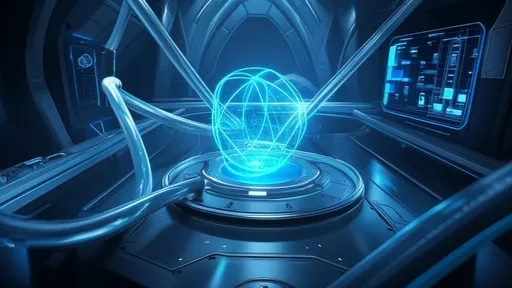
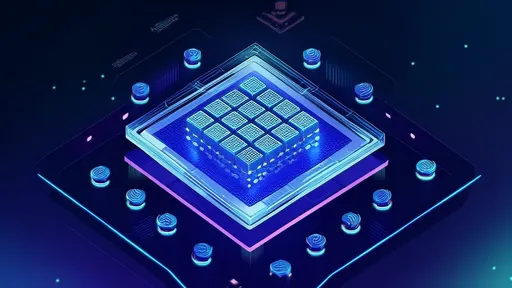
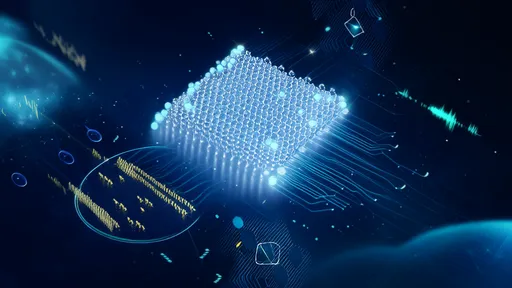
The race to build practical quantum computers has taken a fascinating turn with the emergence of topological quantum processors. Unlike conventional quantum systems that rely on fragile qubits prone to decoherence, these processors leverage exotic nine-dimensional encoding schemes rooted in advanced mathematical constructs. This approach promises to revolutionize error correction in quantum computing by making it intrinsic rather than bolted-on.
At the heart of this breakthrough lies the concept of topological protection - where quantum information gets encoded in the global properties of a system rather than local physical states. Researchers have discovered that certain non-abelian anyons (quasi-particles existing in two-dimensional systems) can naturally perform quantum computations while being remarkably resistant to environmental noise. The nine-dimensional framework emerges from the intricate braiding patterns these anyons create in spacetime.
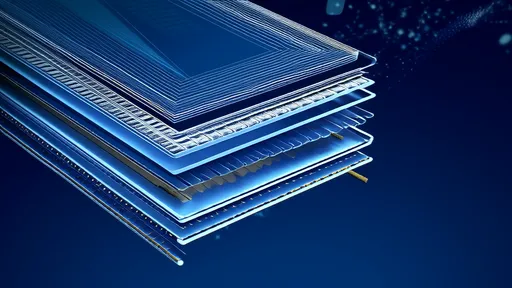
The mathematics behind this approach is as beautiful as it is complex. By utilizing higher-dimensional Hilbert spaces, information becomes distributed across multiple correlated dimensions. Errors that would normally destroy quantum states in traditional systems merely perturb the system without causing catastrophic information loss. This built-in fault tolerance stems from deep principles in algebraic topology and quantum field theory that govern how these systems behave.
Experimental implementations have begun bearing fruit in specialized laboratories. Using carefully engineered materials like fractional quantum Hall systems and topological superconductors, physicists can now create and manipulate these protected quantum states. The nine-dimensional encoding manifests through carefully controlled electromagnetic fields at near-absolute-zero temperatures, where quantum phenomena dominate.
What makes this development particularly exciting is how it addresses quantum computing's Achilles' heel - error rates. Traditional error correction requires dedicating most qubits to protection rather than computation. Topological systems flip this paradigm by making the hardware itself inherently stable. Early estimates suggest error rates could be reduced by several orders of magnitude compared to current superconducting or trapped-ion approaches.
The road ahead still presents significant challenges. Maintaining the delicate conditions needed for topological protection requires extreme precision. Scaling these systems to practical sizes while preserving their quantum coherence remains an open engineering problem. Moreover, the theoretical framework continues to evolve as researchers uncover deeper connections between high-dimensional topology and quantum information science.
Industry observers note that successful development of topological quantum processors could dramatically accelerate the timeline for practical quantum computing. Applications ranging from drug discovery to materials science stand to benefit from machines that can maintain complex quantum states for meaningful durations. The nine-dimensional approach may well represent the missing link between today's noisy intermediate-scale quantum devices and tomorrow's fault-tolerant quantum computers.
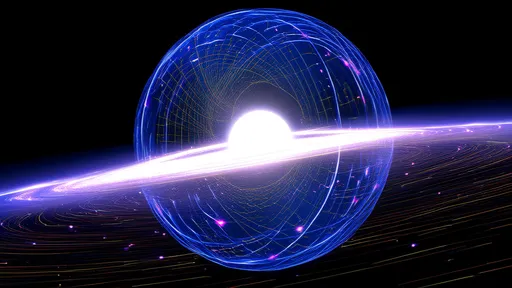
As research progresses, the boundaries between abstract mathematics and practical engineering continue to blur. The topological quantum processor represents perhaps the purest example of how profound theoretical insights can translate into transformative technologies. With several major labs and tech companies now investing heavily in this direction, the coming years may witness quantum computing's equivalent of the transistor revolution - all encoded in the elegant folds of nine-dimensional space.
By /Jul 28, 2025
By /Jul 28, 2025
By /Jul 28, 2025
By /Jul 28, 2025

By /Jul 28, 2025
By /Jul 28, 2025

By /Jul 28, 2025

By /Jul 28, 2025

By /Jul 28, 2025

By /Jul 28, 2025
By /Jul 28, 2025

By /Jul 28, 2025
By /Jul 28, 2025

By /Jul 18, 2025

By /Jul 28, 2025
By /Jul 28, 2025
By /Jul 28, 2025

By /Jul 28, 2025

By /Jul 28, 2025
By /Jul 28, 2025