Beneath the bustling streets of modern cities lies a labyrinth of pipes, cables, and tunnels—critical yet invisible infrastructure that keeps urban life functioning. For decades, mapping these subsurface networks has relied on crude methods: ground-penetrating radar with limited resolution, invasive digging, or outdated paper records. Now, a breakthrough in quantum sensing is rewriting the rules of urban exploration.
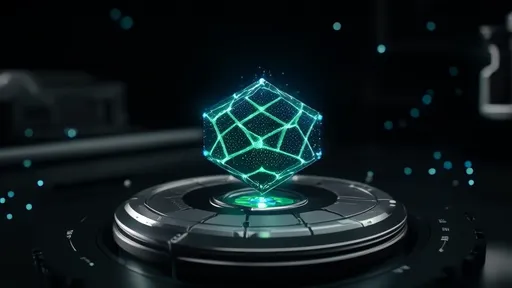
At the heart of this transformation are cold atom gravimeters, devices so precise they can detect density variations caused by a buried sewer pipe or fiber optic conduit. Unlike traditional gravity sensors that measure Earth’s gravitational pull (9.8 m/s²), these quantum instruments track subtle anomalies at the microgal level—equivalent to sensing a grain of sand’s weight difference across a football field. The secret lies in laser-cooled rubidium atoms suspended in vacuum chambers, where quantum interference patterns reveal gravity’s faintest whispers.
How It Works: From Lab Curiosity to City Streets
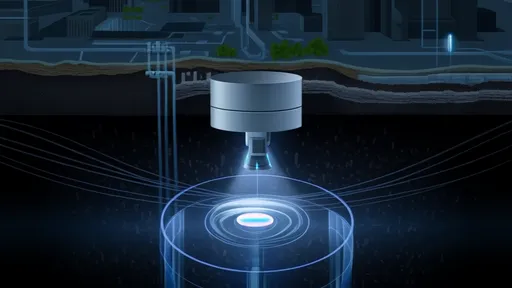
The journey from theoretical physics to municipal utility mapping reads like a scientific odyssey. Researchers at the UK’s National Physical Laboratory first demonstrated portable cold atom sensors in 2016, shrinking refrigerator-sized setups into suitcase configurations. Today’s field-deployable units use interferometry: clouds of atoms chilled to near absolute zero are launched vertically. As they free-fall, lasers split their quantum wave functions, creating overlapping paths sensitive to gravitational gradients. A water main’s void or a gas pipeline’s metal density alters the interference pattern—painting a gravity "shadow" detectable at surface level.
Early adopters like Tokyo’s Metropolitan Government have deployed these sensors atop autonomous rovers, creating 3D subsurface maps with 10-centimeter precision. "We identified a century-old brick storm drain beneath Shinjuku Station that wasn’t in any records," says Dr. Haruto Watanabe, lead geophysicist for the project. "Quantum gravity mapping isn’t just about finding objects—it reveals soil compaction, voids from erosion, even archaeological layers cities forgot."
Beyond Metal Detection: The All-Seeing Quantum Eye
Traditional utility locators fail with non-metallic pipes—a growing problem as cities replace iron water mains with plastic. Cold atom sensors don’t rely on magnetism or conductivity; they "see" any mass discrepancy. In Berlin, a pilot study detected leaking PVC sewage pipes by spotting the moisture halo in surrounding soil. Boston’s "Big Dig" infrastructure team now uses quantum scans to monitor sediment shifts around aging tunnel systems.
The technology’s sensitivity does pose challenges. Passing trucks, subway vibrations, even atmospheric pressure changes require advanced noise filtering. "We’ve developed AI algorithms that distinguish a buried cable from a buried Roman coin," explains MIT’s Professor Elena Rodriguez, whose team refined signal processing techniques. "It’s like listening for a single violin in an orchestra during a thunderstorm."
Cost vs. Catastrophe: The Economics of Quantum Mapping
The next frontier? Satellite-linked sensor networks creating real-time underground "weather maps." Researchers at Caltech recently demonstrated drone-mounted cold atom sensors that could someday autonomously monitor entire cities. As climate change intensifies urban flooding and subsidence risks, quantum gravity imaging may become as vital to city resilience as traffic lights or fire hydrants—an invisible shield against the chaos beneath our feet.
By /Jul 28, 2025

By /Jul 28, 2025
By /Jul 28, 2025
By /Jul 28, 2025
By /Jul 28, 2025
By /Jul 28, 2025
By /Jul 28, 2025
By /Jul 28, 2025
By /Jul 28, 2025

By /Jul 28, 2025
By /Jul 28, 2025

By /Jul 28, 2025

By /Jul 28, 2025
By /Jul 18, 2025

By /Jul 28, 2025
By /Jul 28, 2025
By /Jul 28, 2025
By /Jul 28, 2025
By /Jul 28, 2025
By /Jul 28, 2025